This semester we have spent a lot of time talking about food security and food justice. Both issues are important to talk about and are not the same thing.
Food security is having access to not just food, but healthy nutritious food that can fuel the body and mind. Food security is about eating a meal and not having to worry about when the next meal will be.
Food justice is having the right to grow, sell, and eat healthy foods that are affordable and grown locally, with care for the well-being of workers, the land, and animals.
Both issues effect many people today, and both issues need to be addressed.
Things such as school lunch programs, Feed My Starving Children, and food pantries work to provide food security to people. Food security is not just about patching a whole and moving on. It is about teaching people how to grow food, and how to change their lives to make this food obtainable.
Food justice addresses making sure that healthy food is locally grown, in a sustainable, and humane way. We want to make sure that our farm workers are treated well, which is not always the case.
Food justice and food security are both very important to help the world run smoothly. Today, these topics are not addressed as much as they should be. I urge you to work to make a change in your community, and communities around you to grow healthy, sustainable food, that is accessible to everyone.
This week I was fortunate enough to volunteer my time at Feed My Starving Children. For those of you who don't know, Feed My Starving Children is a Christian run organization, who is working to provide nutritious meals to third world countries.
They focus on giving healthy and filling meals to malnourished children. There is a packing facility, right down the road, in Aurora.
The day I attended we were focusing on packing boxes for El Salvador, Mexico, and Haiti. These are all areas that are extremely malnourished, and need a little extra help to make sure their kids are getting the resources they need to not only survive, but to thrive. Without food, these kids brains and bodies are not able to grow at a normal rate. They become extremely frail and underdeveloped. Feed My Starving Children want to provide food for these children, not so they just aren't hungry, but so they can live a full lifestyle and grow at a healthy pace.
At each station there is a bucket of rice, soy, freeze dried veggies, and a vitamin mix. Two people scoop ingredients into a bag, just like the ones pictured above. The next person holds the bag and then gives it to the weigh-er. The weigh-er is in charge of making sure the bag has 180 to 200 grams. They are in charge of putting in more rice or taking it out when it is needed. The next person is in charge of sealing the bag, and the last is in charge of boxing it. I was the scoooper of the vitamins and rice.
Volunteering at Feed My Starving Children is always so rewarding because you know exactly where the food is headed to, and you see the kids of kids who are receiving the food. They are a great organization and I highly recommend volunteering there!
As a student who lives on campus, I have experience what it is like to live on campus with a car, and without a car. Living on campus and not having a car leaves you with limited options in terms of food. Most of the options served at school are unhealthy, not vegetarian friendly, and served continuously.
My freshman and sophomore year I did not have a car on campus. The only food options that were available were Krasa, Coal Ben, and Starbucks. Krasa is run by Sodexo and since this is such a small campus, there were not many food options. They had a small salad bar every day, and that's as far as they went for healthy options. They also had a small sandwich station, pizza, a grill, pasta, and desserts everyday. Just tasting the food, you can tell that it is not healthy. The next option that we have is "Coal Ben." It is run with a sports bar vibe, and most of the meals are served with fries. The most popular items are burgers, wings, and quesadillas. Below is the picture of the menu. As you can see, they have a Halal portion of the menu, but barely any options for vegetarians.
Another option on campus is Starbucks. There are not many food options at Starbucks, but the food they have is viewed as "healthier," even if it is not. The drinks served are packed with sugar, dairy, and many empty calories. While there are healthier options at Starbucks, most people do not purchase those drinks.
When I finally got a car, I'm sure you can imagine how excited I was for new food options. Within five miles of campus are three grocery stores. There's a Butera, Jewel, and Mariano's. These grocery stores range in prices, foods sold, and overall experiences. There are also many restaurant options. To just list a few; Chipotle, Nando's, Panera, Portillo's, Taco Bell, KFC, Mongolian Grill, Front Street, and Rose Bud are all within a ten minuted drive. Having all these options gave me many more vegetarian options, and made choosing healthy options much easier!
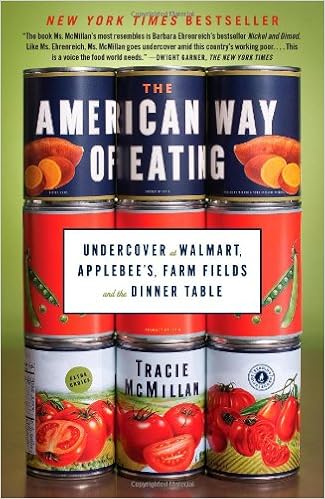
In the book The American Way of Eating, written by Tracie McMillan it talks about her journey through the food industry. She grew up in the Midwest eating cheap meals, never buying organic or fresh foods. She wanted to explore the food industry and gain a better industry of the food justice in the American food industry (McMillan 2012).
She
decided to go undercover for a local magazine to see why these foods are so
expensive, and how they are harvested and treated in supermarkets and fast food
restaurants. She was going to use the wages she earned in each job to live and
eat off. She payed rent and bought groceries as if this job was her real life.
She started off as a laborer in California, harvesting grapes, sorting peaches,
and cutting garlic. Through her journey she
found many disturbing issues with the food system in the United States, including many shocking issues during the farmers harvesting (McMillan 2012).
In all three of her jobs, she found out that the pay was very low, the work was dangerous, and the workers had no rights. Instead of being paid hourly, they were paid by how much they picked. This equated to much less than minimum wage. On top of that the conditions were poor, it was dangerously hot and very dusty. Even if these workers wanted to fight for their rights, they could not. A lot of them came over without legal documentation, so if they tried to fight for rights they would just be deported (McMillan 2012).
McMillian
had a firsthand view of the way that workers are treated in the United States.
They work long hard days, treated poorly, and paid poorly. With the prices that
we pay in grocery stores, these workers should be getting paid more to do what
they are doing. She worked in the fields for a short time, but it felt much
longer because of how tough the work is (McMillan 2012).
The link below takes you to the Agricultural Justice Project. Their goal is to help transform the current agricultural system by empowerment, justice, and fairness for all who labor from farm to retail. They provide farms and food businesses with equipment and tools to improve work and trade practices to help the farmworkers. They work to raise awareness of the injustice occurring in the food system and want to teach people how they can help fix the problem (Agricultural Justice Project).
Steven Rosenbaum, the CEO of Magnify.net, discusses curation and why it is important in today's age. He talks about how the web is a huge place with tons of different information channels. The internet is slowly changing though, instead of algorithms taking over, human content is taking over. People no longer are searching out information made by robots, they want real-life stories, testimonials, and content. Human content, in the form of curation, helps others learn more about life experiences (Innovate -- curation! 2011).
In the food justice industry, people are searching for real-life testimonials of people who are passionate about food justice. So what is food justice? According to What is Food Justice, "Food Justice is communities exercising their right to grow, sell, and eat healthy food. Healthy food is fresh, nutritious, affordable, culturally-appropriate, and grown locally with care for the well-being of the land, workers, and animals. People practicing food justice leads to a strong local food system, self-reliant communities, and a healthy environment" (WHAT IS FOOD JUSTICE 2018).
The website above is a non-profit organization located in New York City. They started in 1995, and their goal is to use sustainable agriculture by having an emphasis on community-driven food. Not only do they want to have sustainable food, but they engage individuals in the community to help feed, educate, and advocate for each other no matter their social, racial, economic, and environmental background (WHAT IS FOOD JUSTICE 2018).
They offer a community-run farmers' market network that offers both urban growers and regional farmers. They focus on serving low-income communities and rely heavily on volunteers. They also offer community food education with educational workshops. These workshops include nutritionists, professional chefs, food activists, parents, food lovers and more (WHAT IS FOOD JUSTICE 2018).
References
WHAT IS FOOD JUSTICE? (n.d.). Retrieved March 12, 2018, from
http://justfood.org/advocacy/what-is-food-justice
Innovate -- curation! (2011, June 06). Innovate -- curation! | Steve Rosenbaum | TEDxGrandRapids. Retrieved March 12, 2018, from https://www.youtube.com/watch?time_continue=6&v=iASluLoKQbo
Growing up in a small town the food options in
my school district were very slim. There was one lunch offered a day, no
alternatives for students with allergies, intolerances, and no healthy options.
Without fail, year after year, the highlight of my day was chicken nuggets,
Bosco sticks, and pizza. Once we got to middle school, our school offered what
I thought was tons of options. The problem was the food they offered was pizza,
chicken nuggets, cheese fries, and hamburgers. I had no concept of the junk I was
putting in my body to fuel it.
In the link below, What’s
Wrong with School Lunches, Cooper states, “We're seeing sick kids get
sicker and sicker. And the reason this is happening, by and large, is because
of our food system and the way the government commodifies food, the way the
government oversees our food, the way the USDA puts food on kids' plates that's
unhealthy, and allows unhealthy food into schools. And by -- tacitly, all of us
send our kids, or grandchildren, or nieces, or nephews, to school and tell them
to learn, you know, learn what's in those schools. And when you feed these kids
bad food, that's what they're learning. So that's really what this is all
about” (Cooper, 2007). Cooper agrees that school lunches are not only
unhealthy, but they are, teaching students that eating those foods is good for
them. She says that the only way to fix this growing problem is for everyone to
step up and help stop it. Whether it’s petitioning for healthier schools in
your district or simply packing lunch for your child, anything will help.
When
thinking about the effects of eating unhealthy foods most people just think
about weight gain, but have you ever thought about the other effects these
children have? Think about the children who do not have consistent meals, the
only food they receive is food they get from school. They come to school, their
brains are foggy, and all they can think of is their next meal. These students
need nutritious, filling meals that will keep their mind and bodies fueled. In
his TED Talk, Kass talks about how he instituted a program for all schools who
had a forty percent more low-income kids. Every student in this school would
receive not only a free lunch, but also a free breakfast. These kids would come
to school and not have to sit and wait for their first meal of the day, instead
they would start off with a meal. Kass stated that, “The schools that have
implemented this program saw an increase in math and reading scores by 17.5
percent. 17.5 percent. And research shows that when kids have a consistent,
nutritious breakfast, their chances of graduating increase by 20 percent. 20
percent. When we give our kids the nourishment they need, we give them the
chance to thrive, both in the classroom and beyond” (Kass, 2015). When we think
about school lunches, we need to think about the effects that they have on
every child. Most importantly, the children who do not receive consistent meals
at home. They are the ones lacking the nutrients they need to grow and
function, they are the ones we need to make sure are receiving nutritious
meals.
I
believe that schools are starting to take the right steps towards improving
school lunches. If I were to look back at the school lunches I was fed as a
child, and now look at the one my brother receives, there have been vast
improvements. At my brother’s school there are four lunches served a day. The
normal lunch special, a vegetarian option, a gluten free option, and a salad.
They can choose their sides and can opt for healthier options. His school even
offers breakfast to students and healthy snacks for students who do not have
one, or who forgot theirs at home. With the option of these healthy meals, the
real question is, are these students picking the healthier option? Thanks to
the Obama administration, school lunches are starting to become healthier with
less options of junk food. “The amounts of fat, sugar and salt were drastically
reduced. Portion sizes shrank. Lunch trays had to hold more fruits and
vegetables. Snacks and food sold for fund-raising had to be healthier”
(Severson). If we want children to live longer, grow up healthy, and perform
well in school, we need to make sure they are receiving proper nutrition to
fuel their bodies. While I believe that school lunches are not perfect, I
believe there have been steps made towards a healthier future of school
lunches.
References
Cooper, A. (2007, December). What's wrong with
school lunches Retrieved February 12, 2018, from https://www.ted.com/talks/ann_cooper_talks_school_lunches/transcript?
Kass,
S. (2015, November). Want kids to learn well? Feed them well. Retrieved
February 12,
In the book Food Justice by Gottlieb and Joshi,
they talk about multiple issues within the food system that have affected the
world. On pages 59-73 and 87-91 they specifically talk about the issues of
standardization of food, cooking becoming a lost skill, the increase of
obesity, fast food companies targeting children, and school lunches. These
issues are still issues today and these authors want to point out the problems
they have noticed in hopes of changing the way food is looked at.
Fast food over the
centuries has led to a standardization of food. There are many critics who say
that fast food is changing the way food is viewed. The growth in the fast food
industry has led to the loss of home cooked meals. School lunches sped up the
decrease of home-prepared meals because children now had a readily accessible
meal waiting for them at home (Gottlieb, 2013).
Post-World War II
cooking started to become a lost skill. This is largely due to an increase in
products such as microwaves and instant cookers that were made to speed up the
cooking process. During World War II women were not only homemakers, but they
worked jobs while their kids were at school. These convenient foods helped
women save time and energy. There was also an increase in the number of
convenient foods and fast food options. Foods such as dried soup mixes and
canned soups were emphasized over homemade soups with fresh ingredients
(Gottlieb, 2013).
The increase in fast
foods and convenient food options lead to a major increase in obesity. There
was an emphasis on fast and convenient with little to no emphasis on the
nutritional value. Fast food companies have specifically targeted two
vulnerable groups- children and low income residents. With the huge portion
sizes and the low prices low income residents are drawn to fast food to fill
their stomachs. "According to the County Public Health Department, the
area in South Los Angles with the highest rate of poverty and food insecurity
in the county also had the highest rates of obesity among adults (68)."
A major problem is the
targeting of fast food restaurants to children. These kids see these delicious
foods advertised and get hooked on the brands. Companies like McDonalds build
product loyalty and establish effective viral marketing to draw in children.
These parents like the convenience and ease of these restaurants as well as
making their children happy (Gottlieb, 2013).
School food politics:
During World War I school lunches became under scrutiny when a third of those
called to serve the country were considered malnourished. President Truman
signed the National School Lunch Act in 1946 saying that the welfare of farmers
directly correlated with the health of children. While programs like these
helped feed our youth, they did nothing to ensure the quality of the meals they
are being fed. The meals were focused on providing the right number of
calories, not the proper nutritional value. In 2009 Obama and his agriculture
secretary pushed to make changes in the broader food system, and help increase
the nutritional value of school lunches (Gottlieb, 2013).
Gottlieb and Joshi make
many valid points that should be analyzed even closer. The only way to increase
the longevity of life is to ensure that we are fueling our body with the proper
nutrients. I think the first step in fixing this is looking at the way
companies target young children, as well as the addressing the nutritional
value of school lunches.
References
Gottlieb, R., &
Joshi, A. (2013). Food justice. Cambridge, MA: The MIT Press.
One way to describe my food identity is a melting pot of all different cultures. This may be why my favorite meal I've ever had was a Christmas Eve Mexican feast. Ironically, I have never been to Mexico, but I have always loved trying to recreate their food. This meal was so special not only because it was delicious, but because I was able to spend it with family members who I loved.
A big part of my life consists of traveling and experiencing different cultures. One of my favorite parts of traveling is going to restaurants and experiencing the local foods that different countries have to offer. When I went to England I had a dish called a pasty, a pastry crust filled with vegetables. I also tried my first Indian dish while in Bath, England. It was kind of like a pancake filled with vegetables and served with a tomato and mango dipping sauce.
When I went to Sweden I had a vegetarian version of Swedish meatballs. It was served with mashed potatoes, a side salad, and some type of sweet berry.
These two dishes pictured above are one of many dishes I have tried in other countries and now try and create in my own kitchen. Traveling is a huge part of me, and with that comes me loving to try different kinds of foods. Making these dishes helps me to reflect back on all my trips, and reminds me of all the good times I have had exploring the world.
While I may not be able to match all of the flavors these authentic dishes have, I adapt them to my own tastes and preferences. One thing I have noticed while traveling is that in tourist areas restaurants are much less authentic to the culture. They try and create dishes that all different cultures will enjoy, even if this means sacrificing their cultural identity.
For example, when I was in Stockholm I purchased a mocha at a chain restaurant called Espresso house. This coffee was not at all like normal Swedish coffee. Since we were in such a touristy area they added more sugar to appease the taste buds of travelers from different countries.
While this mocha was good, it got me thinking. Why do other countries feel the need to change their cultural identity for other cultures to enjoy their food? We should be embarrassing the culture we are in and enjoying their food as they cook it, not an Americanized version. When I look back at my favorite Mexican meal, I realize how different it is from authentic Mexican food. One day I hope I get the chance to travel to Mexico to enjoy their local cuisine.